
Suffragette Jewellery: A Beautiful Act of Rebellion
I have a real soft spot for jewellery with a story behind it, and there aren't many stories more powerful than this one. Right now, sitting in our showcase on Cambridge Street, we have a genuine piece of suffragette jewellery, and every time I walk past it, I think about the woman who first pinned it to her coat.
So let me tell you why a ring, a brooch, or a pendant in three particular colours once meant so much more than decoration.

The suffragette pendant we currently have online and in-store at Fogal & Barnes
A Movement Told Through Colour
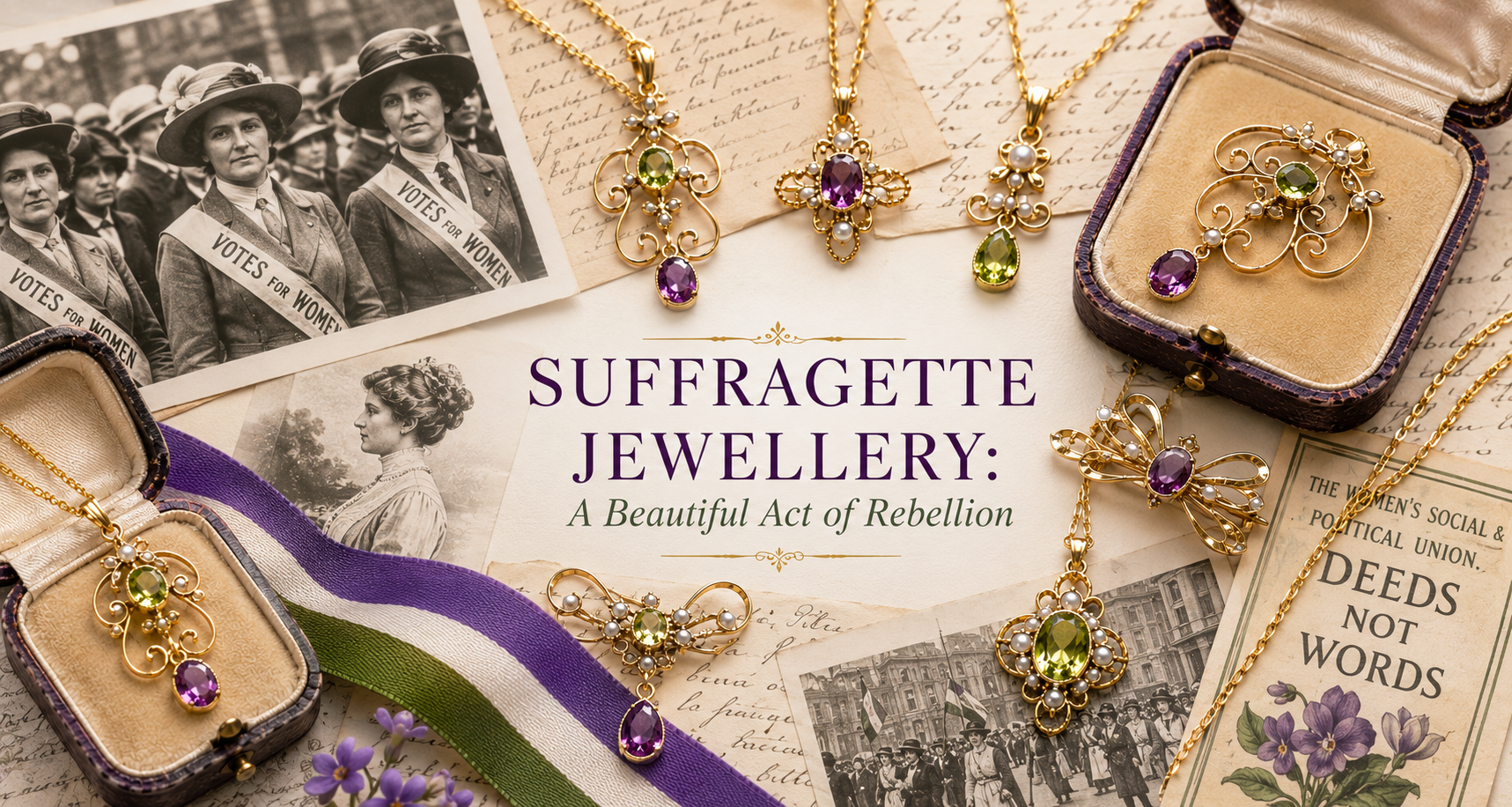
Back in 1908, the Women's Social and Political Union, the WSPU, led by Emmeline Pankhurst, made a decision that would quietly change the face of Edwardian jewellery. They chose three official colours for the movement: purple, white and green. Pankhurst herself explained it best in the union's newspaper, Votes for Women, describing purple as the colour of royal blood and dignity, white as purity in public and private life, and green as hope and the freshness of spring.
Those three colours started appearing everywhere. Sashes, banners, scarves, rosettes, and, most beautifully of all, jewellery.
Wearing a green, white and violet brooch or ring to afternoon tea in 1910 wasn't just a fashion choice. It was a quiet, deliberate statement of allegiance to a cause that plenty of people in polite society still found deeply uncomfortable. A woman could sit in a drawing room, perfectly ladylike, and be silently declaring exactly where she stood.
You'll often see this colour scheme explained as a secret acronym: Green for Give, White for Women, Violet for Votes. It's a lovely story, and it's one I've told myself in the past. But I want to be straight with you, because accuracy matters to me. Some jewellery historians, including curators who look after the Museum of London's suffragette collections, have pointed out there's no solid evidence the WSPU ever intended it as a hidden code. What we do know for certain is that these three colours became the unmistakable, official palette of the movement, and jewellers of the day ran with it.

An enamel suffragette pin - image courtesy of the Museum of London
The Gemstones Behind the Symbolism
Edwardian jewellers had exactly the right materials to hand. This was the golden age of platinum settings, delicate millegrain edges, and garland-style motifs, so translating a political colour scheme into something genuinely beautiful wasn't difficult.
- Green usually meant peridot, which happened to be a favourite of King Edward VII and was already hugely fashionable, or the rarer, fierier demantoid garnet, newly discovered in Russia's Ural Mountains and causing something of a sensation in Europe at the time.
- White was almost always pearls or diamonds, sometimes set alongside crisp white enamel.
- Violet meant amethyst, prized for its rich, regal colour, or occasionally deep purple enamel work.
Purple and green also happen to sit opposite each other on the colour wheel, which is partly why these pieces have such striking, complementary contrast. They photograph beautifully even now, well over a century later.
Beyond the three-colour pieces, there's a whole other layer of genuinely rare suffragette jewellery worth knowing about. The Holloway brooch, designed by Sylvia Pankhurst, was presented to women released from Holloway Prison after imprisonment for the cause, its purple, white and green ribbon draped over a silver portcullis. Pieces like that carry a weight far beyond their gemstones.
Why Edwardian Style Suited the Movement So Well
The Edwardian era, roughly 1901 to 1910, was already leaning towards lightness and femininity in jewellery design. Platinum had replaced heavier silver-topped gold settings, allowing for finer, lace-like work. Garlands, bows, ribbons and honeysuckle motifs were everywhere, and the whole aesthetic was softer and more delicate than the bold Victorian pieces that came before it.
That femininity mattered to the suffragettes, arguably more than we might assume today. There was a real determination within the movement to counter the caricature of the "unladylike troublemaker." Wearing exquisite, fashionable, unmistakably feminine jewellery was part of the message: that a woman could hold deep political conviction and still be entirely elegant. The two were never in conflict.
"Purple stands for the royal blood that flows in the veins of every suffragette, the instinct of freedom and dignity. White stands for purity in private and public life. Green is the colour of hope." — Emmeline Pankhurst, Votes for Women, 1908

A suffrage medal, in the movement's green, white and purple. Image courtesy of the Museum of London
The Piece We Currently Have
I mentioned it at the start, and I'll say it properly now. We currently have a genuine Edwardian-era suffragette piece in the shop, set with peridot, seed pearl and amethyst in the classic tricolour arrangement. Pieces like this don't come along often, and when they do, I like to make sure they go to someone who understands what they're holding, not just a pretty ring but a small, wearable piece of women's history.
If you'd like to see it, pop into the boutique on Cambridge Street or give us a call to check it's still available before you visit.
And if you happen to have a piece of suffragette or genuine Edwardian jewellery of your own, whether inherited, tucked away in a drawer, or simply no longer worn, I'd love to hear from you. We're always keen to buy pieces of real history like this, and I'll always give you an honest, fair valuation.
Pop in and see us at 14 Cambridge Street, Harrogate, or get in touch and we'll take it from there.
Mona x