
What to Look For When Buying Vintage or Pre-Loved Jewellery
Some of my favourite pieces in the shop aren't new at all. There's something about a ring or necklace that's already lived a life before it finds you - it's got a bit of history, a bit of character, and usually a story we'll never fully know. I love that.
At Fogal & Barnes we have a small, carefully chosen selection of vintage and pre-loved jewellery alongside our bespoke pieces, both in our Cambridge Street shop and online. But buying vintage or pre-loved isn't quite the same as buying new, so here's what I'd want you to know before you part with your money.
Why Buy Pre-Loved Jewellery?
There are so many good reasons, and they go well beyond "it's pretty."
It's the sustainable choice. Buying pre-loved jewellery means no new mining, no new resources, nothing extra taken from the earth. Every piece that's recirculated is one less piece that needs to be newly made, and in an industry where the environmental and ethical footprint of mining is a concern, that's no small thing. You're simply giving a beautiful piece a second (or third, or fourth) life rather than asking the earth for more. For a lot of our customers that matters just as much as the look of the piece itself, and it's a lovely thing to be able to say about your engagement ring.
It's often better value. Pound for pound, vintage and antique pieces tend to offer more craftsmanship and more gemstone for your money than buying new. You're not paying for brand-new manufacturing costs, marketing, or a high street mark-up, you're paying largely for the piece itself, the metal, and the stone. This is especially true with older diamonds and gemstones, which were often cut by hand with a real eye for the stone rather than to a strict modern formula. It means your budget can sometimes stretch further than you'd expect, whether that's a bigger stone, a better quality of gold, or simply more jewellery for your money.
It comes with history. Whether it's an Art Deco engagement ring, a Victorian locket, or a chunky 1980s gold bracelet, every vintage piece has already been part of someone else's story. It might have been worn to a special party or occasion, it might have travelled the world or lived on somebody's wrist through the big moments in history. You'll probably never know the full story, but you become the next chapter, which I think is rather lovely. There's a warmth to wearing something with a past, in a way a brand-new piece simply can't replicate.
It's properly unique. Older pieces were often handmade or finished by hand, with details, proportions, and little quirks you simply don't see in modern mass production; a slightly asymmetric setting, a hand-engraved gallery, a cut of stone that isn't quite "perfect" by today's standards but is all the more characterful for it. No one else is walking around with quite the same ring, and for a lot of people, that's exactly the point. If you've ever felt like every modern engagement ring looks a bit the same, vintage is often where you'll find the answer.

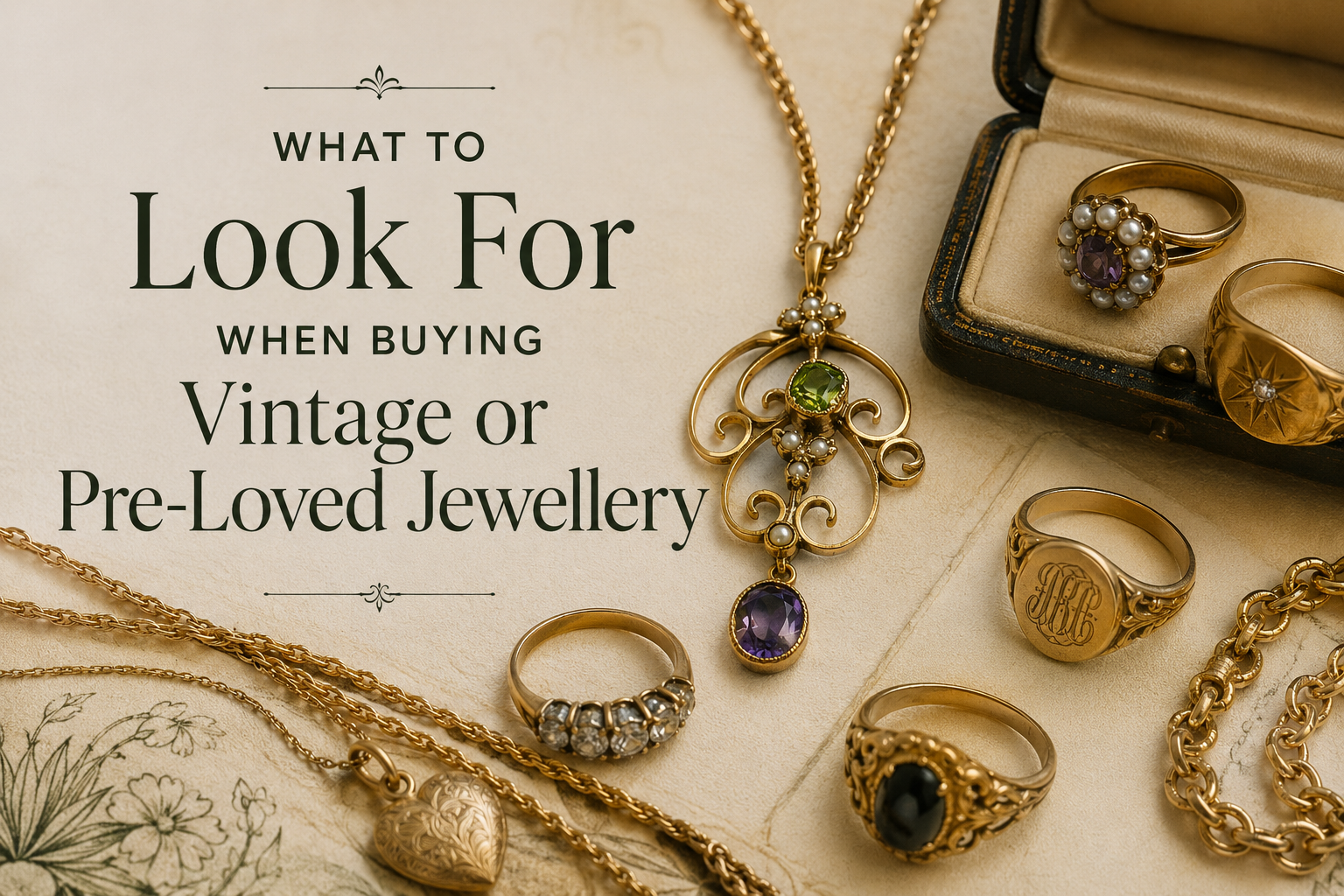
One of our pre-loved items, a vintage piece of Suffragette jewellery. During the suffrage movement in the UK, items with pearl, peridot and amethyst were worn to indicate support for the cause, the colours reflective of those of the Women's Social and Political Union
Antique, Vintage, or Pre-Loved - What's the Difference?
People use these words interchangeably, but they actually mean different things, and it's worth knowing the distinction:
- Antique - generally means the piece is over 100 years old.
- Vintage - typically refers to pieces that are 20 to 99 years old.
- Pre-loved (or secondhand) - simply means it's been owned before, regardless of age. A pre-loved piece might be five years old or fifty.
So a piece can be pre-loved without being vintage, but every antique or vintage piece is, by definition, pre-loved too.

We have a wide selection of pre-loved gold chain in store and a online
Understanding Hallmarks
If you're buying precious metal jewellery in the UK, hallmarks are your best friend, and it's worth taking a minute to really understand them before you buy. Hallmarking has been a legal requirement in this country since 1300, which makes it one of the oldest forms of consumer protection in the world, so when you see a proper hallmark, you're looking at a tradition that's been protecting buyers for over 700 years.
A hallmark is a set of small stamped marks, usually found on the inside of a ring band, the back of a pendant, or the clasp of a bracelet or necklace. Because they're so small, you'll often need a loupe or a jeweller's eyeglass to read them properly - don't be surprised if you need a bit of help. A full UK hallmark typically includes:
- The maker's mark - a unique stamp identifying the jeweller or workshop that made the piece. On vintage pieces, this can sometimes be traced back to a specific named workshop, which adds a lovely bit of provenance.
- The fineness mark - confirms the metal purity in parts per thousand (for example, 375, for 9ct gold, 750 for 18ct gold, 585 for 14ct gold, 925 for sterling silver, or 950 for platinum). This is the mark that tells you exactly what you're buying, metal-wise.
- The assay office mark - shows which UK assay office tested and marked the piece. There are currently four: London (a leopard's head), Birmingham (an anchor), Sheffield (a Tudor rose), and Edinburgh (a castle). Each has its own symbol, and on older pieces you may also see the historic mark for the now-closed Chester assay office.
- The date letter - a single letter in a particular typeface and shape that tells you the exact year a piece was hallmarked. Each assay office has cycled through the alphabet in slightly different styles over the centuries, so with the right reference table, this letter alone can date a piece precisely.
- Additional marks, such as a special commemorative mark, may also appear on certain pieces from significant years (Jubilees, anniversaries, and so on), which can be a lovely extra bit of history.
A genuine, legible hallmark gives you real reassurance about exactly what you're buying. If a piece is described as solid gold or silver but has no hallmark at all, or the marks are worn beyond recognition, it's worth asking some careful questions before you part with your money.

Many customers opt for pre-loved wedding of engagement rings, choosing items that have their own history
What to Check for Quality
This is the part people often skip, and it's the part that matters most. Vintage pieces have been worn, loved, and lived in, so a proper once-over is essential.
Check for plating. Many older pieces, especially rolled gold or gold-plated items, can show wear where the base metal underneath starts to peep through: usually at the back of a ring or high-touch points. A bit of wear isn't a dealbreaker, but you should know it's there and price accordingly.
Check the settings. Give the piece a gentle once-over for any stones that wiggle, claws that have worn thin, or settings that look stretched or distorted. A stone that's about to fall out is a far bigger job to fix than most people expect.
Check the clasp or catch. On necklaces and bracelets, make sure the clasp closes securely and isn't worn so thin it could snap.
Check the band or shank. On rings, look for thinning at the back of the band- a sign of decades of wear that may need building up before the ring can be worn day to day.
Ask about resizing. Older rings were often sized for smaller fingers than we tend to have today, and some vintage settings (particularly very delicate or filigree work) can be tricky or risky to resize. Some rings with diamonds all the way around the band or set in a particular style are unable to be resized at all, so always ask before you fall in love with the fit.
Honestly, my advice is always the same: if you're not completely sure what you're looking at, bring it to a jeweller you trust and ask them to check it over before you buy. We're always happy to do this for customers, whether or not the piece came from us.
Visit Us or Shop Online
Our vintage and pre-loved selection changes regularly, so it's always worth popping in to see what's currently in the cabinet, or having a browse online. And if you've got a piece at home you're thinking of parting with, our gold and jewellery buying service means we might just be the ones to give it its next life too.
If you'd like to come and see what we have in, we're at 14 Cambridge Street, Harrogate.
Mona x