
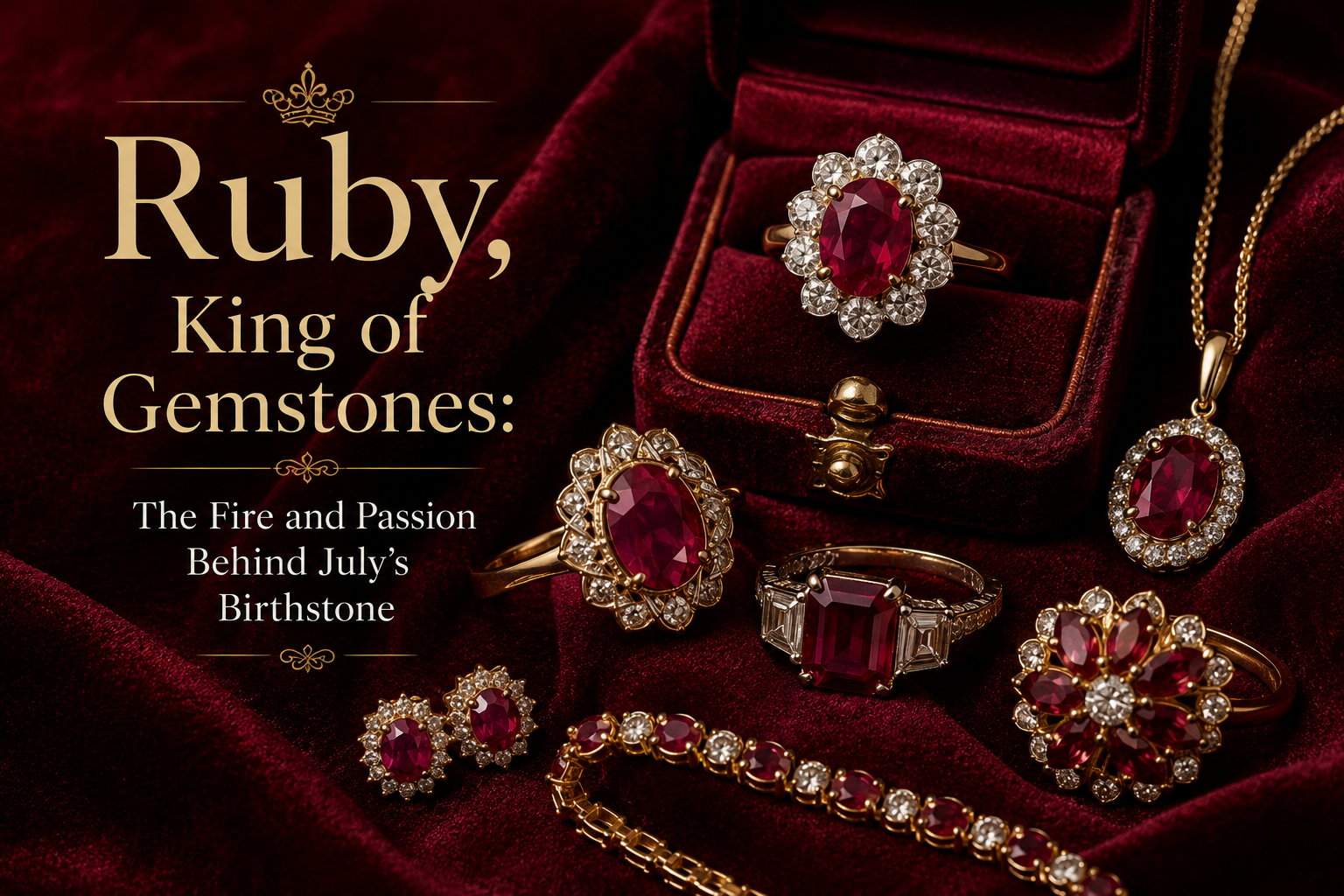
Ruby, King of Gemstones: The Fire and Passion Behind July's Birthstone
There's a reason ruby has been called the king of gemstones for thousands of years, and it isn't just the colour. It's everything that colour has come to represent: passion, courage, and a kind of regal authority that very few stones can claim. Emperors wore it believing it made them invincible, warriors carried it into battle for protection, and entire dynasties prized it above almost anything else the earth could produce. If you've got a July birthday, or you're simply drawn to that particular shade of red that feels somewhere between a heartbeat and a flame, you're inheriting a story that's been told for millennia.
What Actually Is a Ruby?
Here's a bit of gemmology that surprises a lot of people in the shop: ruby and sapphire are actually the same mineral. Both are corundum, and the only thing that separates them is colour. Trace amounts of chromium give corundum its red colour, and once it crosses a certain depth of colour, it stops being called "red sapphire" and earns the name ruby. Every other colour of corundum, from blue to pink to yellow, is technically a sapphire.
That chromium is also responsible for ruby's famous fluorescence, the reason a fine ruby seems to hold its own light, even in a dim room. It's a genuinely unusual property among coloured gemstones, and it's part of why the best rubies are so difficult to replicate convincingly.

A beautiful ruby ring, with a deep, rich hue
A Stone Fit for Kings
The Sanskrit word for ruby is ratnaraj, which translates roughly to "king of precious stones." That wasn't a marketing flourish, it was a genuine belief held across cultures for millennia. In ancient India, rubies were offered to the god Krishna in the hope of being reborn as an emperor. Burmese warriors are said to have inserted rubies into their skin before battle, convinced the stone would make them invincible.
Medieval Europeans had their own superstitions. A ruby was thought to darken when danger was approaching its wearer, acting as an early warning system, and to return to full colour once the threat had passed. Whether or not anyone actually trusted their ring over their own instincts, it tells you how much power was attributed to this stone.
There's a wonderful correction I like sharing with clients here, because it shows that even royal collections get it wrong sometimes. The Black Prince's Ruby, set into the Imperial State Crown and worn by British monarchs since the 1300s, isn't a ruby at all. It's a red spinel, a different mineral entirely that simply wasn't distinguished from ruby until gemmological science caught up centuries later. It's a useful reminder that with coloured gemstones, history and chemistry don't always agree, and proper identification matters more than ever.

Some of the beautiful ruby rings that adorn our window
What Ruby Is Said to Mean
Strip away the legends and you're left with symbolism that's barely changed in thousands of years: passion, protection, vitality, and courage. Ruby has long been associated with the heart, both literally, given its deep red, and emotionally, as a stone linked to love and devotion. It's also traditionally given to mark a 40th wedding anniversary, which makes it a beautiful choice for couples wanting to mark a long marriage with something as bold as the years they've put in.
For a July birthday specifically, ruby is said to bring confidence and strength to its wearer. I'm not going to tell you whether that's literally true. What I will say, having handled enough of these stones now, is that there's something about wearing a ruby that does make you stand a little taller. It's not a quiet stone, and it doesn't ask you to be quiet either.

8 marquise-cut diamonds, set into 2 stud earrings to create a floral effect
Where Fine Rubies Come From
The most celebrated rubies in history have come from the Mogok Valley in Myanmar (Burma), prized for a colour gemmologists still describe using the old term "pigeon's blood": a pure, slightly purplish red with intense saturation. Burmese rubies remain the benchmark against which others are measured, though fine material also comes from Mozambique, Madagascar, Sri Lanka, and Thailand, each with its own subtle character in colour and clarity.
Natural rubies of real size and clarity are genuinely rare, rarer than fine diamonds in many cases, which is why we tend to talk clients through their options carefully. Natural rubies carry the rarity, history, and individual character that comes from something the earth has been forming for millions of years, with the kind of inclusions that prove it. Lab-grown rubies are chemically identical to natural stones and offer a way to get a larger, more vivid stone at a more accessible price point, which can be the right call for a client who wants scale and saturation over provenance. There's no wrong answer here, just a conversation about what matters most to you.
A Ruby Worth Commissioning
I always think July birthstone pieces lend themselves beautifully to bespoke ring and bespoke jewellery commissions, far more than people expect. A ruby has the presence to anchor a design on its own, set simply in gold to let the colour do the talking, or surrounded by a halo of diamonds for something with more drama. It also works wonderfully in heirloom redesigns, where an old, perhaps slightly tired ruby piece can be reset into something that actually gets worn.
If you've got a ruby sitting in a drawer, inherited or otherwise, that's a conversation worth having. Coloured stones like this often survive generations far better than their settings do, and there's real satisfaction in giving an old stone a new life rather than starting from scratch.
We work with clients across Harrogate and further out into Leeds, York, Bradford and Knaresborough on commissions exactly like this, and a July birthstone piece is one of my favourite reasons to get the sketchbook out.
If you've got a ruby in mind, whether it's a birthday gift, an anniversary piece, or an old stone waiting for a new setting, pop into the shop on Cambridge Street and let's talk it through. I'd love to see what you're picturing.
Mona x
Fogal & Barnes Fine Jewellers, 14 Cambridge Street, Harrogate, North Yorkshire