
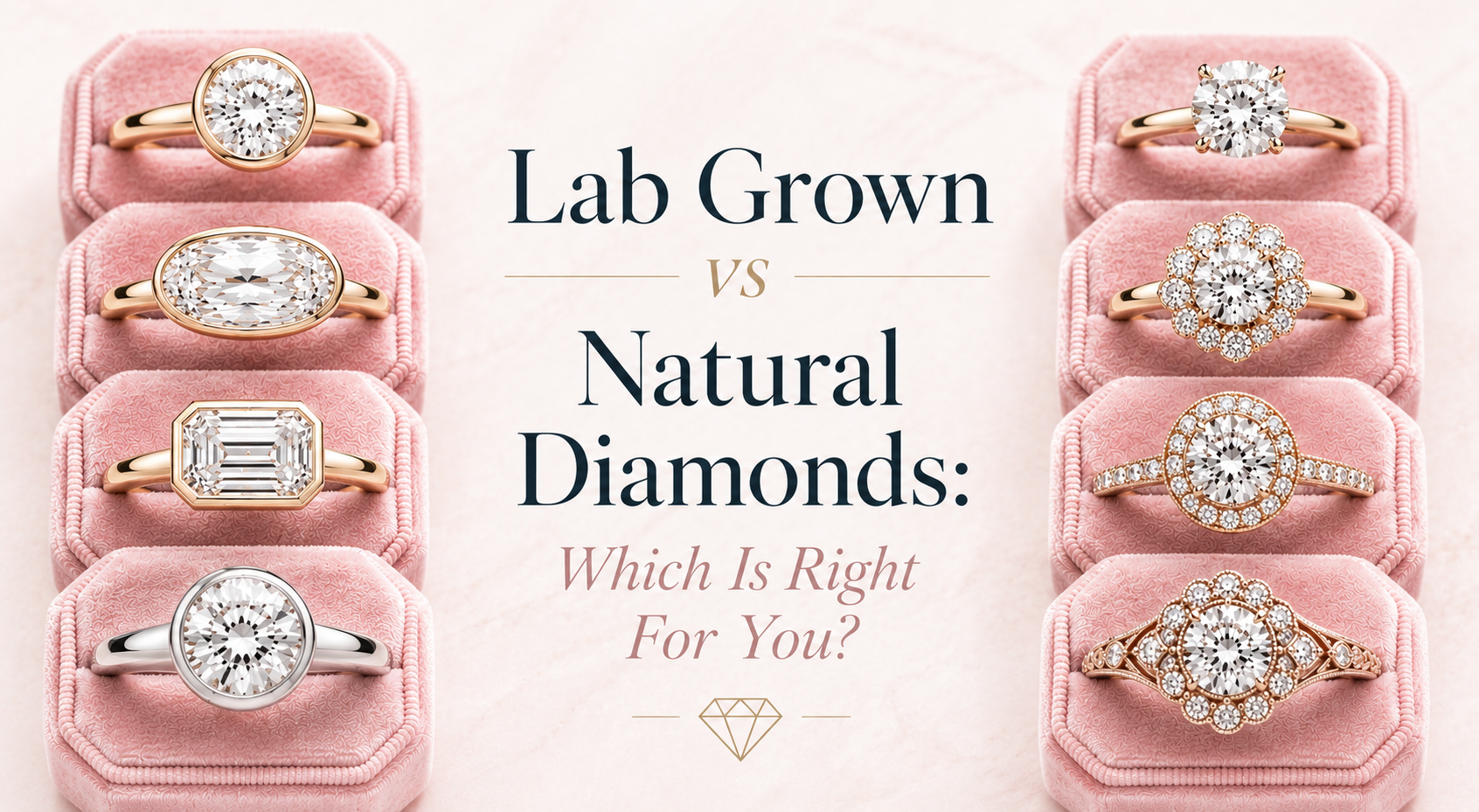
Lab Grown vs Natural Diamonds: Which Is Right For You?
It's the question I get asked more than almost any other right now - should I go lab grown or natural?
And honestly, there's no wrong answer. Both are real diamonds, both are beautiful, both can make a ring you'll treasure forever, but they are different, and those differences matter depending on what's important to you.
So let me break it down; no jargon, no sales pitch, just the honest truth from someone who works with both every single day.
First things first - is a lab grown diamond a real diamond?
Yes. Absolutely, categorically, yes.
A lab grown diamond is chemically and physically identical to a natural diamond. Same hardness, same brilliance, same sparkle. Even trained gemologists can't tell them apart with the naked eye - specialist equipment is needed to spot the difference. They're graded using exactly the same standards: cut, colour, clarity, and carat.
The only difference is origin: a natural diamond formed deep within the earth over billions of years, whereas a lab grown diamond replicates that process in a controlled environment, in weeks rather than millennia.
That's it. One is made by the earth. One is made by science. The diamond itself? The same.
The case for lab grown diamonds
You get significantly more for your budget
This is the big one. In 2026, a 3 carat lab grown diamond ring can cost as little as £2,500-£3,000. The equivalent natural diamond? You're looking at £30,000-£50,000 for the same quality diamond alone, sometimes considerably more. That's not a typo.
For couples who've always dreamed of a big, brilliant stone, lab grown makes it genuinely possible. We see it all the time in the studio. Clients who come in thinking they'll have to compromise, and leave with a ring that genuinely takes their breath away, and with a huge smile on their face.
The quality is consistently excellent
Because lab grown diamonds are produced in controlled conditions, the quality tends to be very high. You're far more likely to find a D-F colour, VS1+ clarity stone at an accessible price point than you would with a natural diamond in the same budget.
They're a more environmentally conscious choice (somewhat)
No mining means a lighter environmental footprint, and for couples who care about where things come from, that absolutely matters. But I want to be honest here, because you'll hear some big claims and it's worth knowing the full picture.
Lab grown diamonds still require significant energy to produce. The machines that grow them - particularly those using high pressure and gas compression - consume a great deal of power. The environmental impact depends heavily on how that energy is sourced, and not every lab operates on renewables. So while lab grown is generally the cleaner option, it isn't entirely without footprint. Nothing is.
The case for natural diamonds
They hold their value better
This is where I'll be honest with you, even if it's not what everyone wants to hear. Natural diamonds hold their resale value considerably better than lab grown stones. Lab grown diamond prices have fallen sharply in recent years as production has scaled up, which is great for buyers, but means the stone you buy today may be worth significantly less if you ever came to sell it.
Natural diamonds, particularly exceptional or larger stones, have a much more established secondary market and tend to retain value over time.
The romance of rarity
There's something about knowing your diamond took billions of years to form, deep within the earth, that adds a layer of meaning for many people. It's not logic, it's emotion. And when it comes to an engagement ring, emotion matters.
A natural diamond is rare in a way that simply can't be replicated. That rarity is part of the romance. For many of our clients, that story is worth everything.
They're a true heirloom piece
Natural diamonds have been passed down through families for generations, and will continue to be. There's a reason your grandmother's ring still sparkles just as brilliantly today. Natural diamonds don't age, don't fade, and don't depreciate the way lab grown stones currently do. For couples thinking about the long term, this is worth considering.
So which should you choose?
Here's my honest advice:
Choose lab grown if: you want maximum size and sparkle for your budget, you're not concerned about resale value, and you love the idea of a modern, forward-thinking choice.
Choose natural if: the origin and rarity of the stone matter to you, you're thinking about this as a long-term investment or heirloom, and you want the romance that only billions of years of geology can provide.
Neither is wrong. Both are diamonds, both are beautiful, and both can be set into the most stunning bespoke ring you've ever seen, which is exactly what we do here at Fogal & Barnes.
Come and see both side by side
The best way to decide? Come in and see them for yourself. In the studio, I can show you lab grown and natural diamonds side by side, talk through your budget, and help you find the stone that feels right for you.
Book a bespoke consultation with us at 14 Cambridge Street, Harrogate - there's no pressure, no rush, just an honest conversation and expert advice.
Mona x
Fogal & Barnes Fine Jewellers, 14 Cambridge Street, Harrogate