
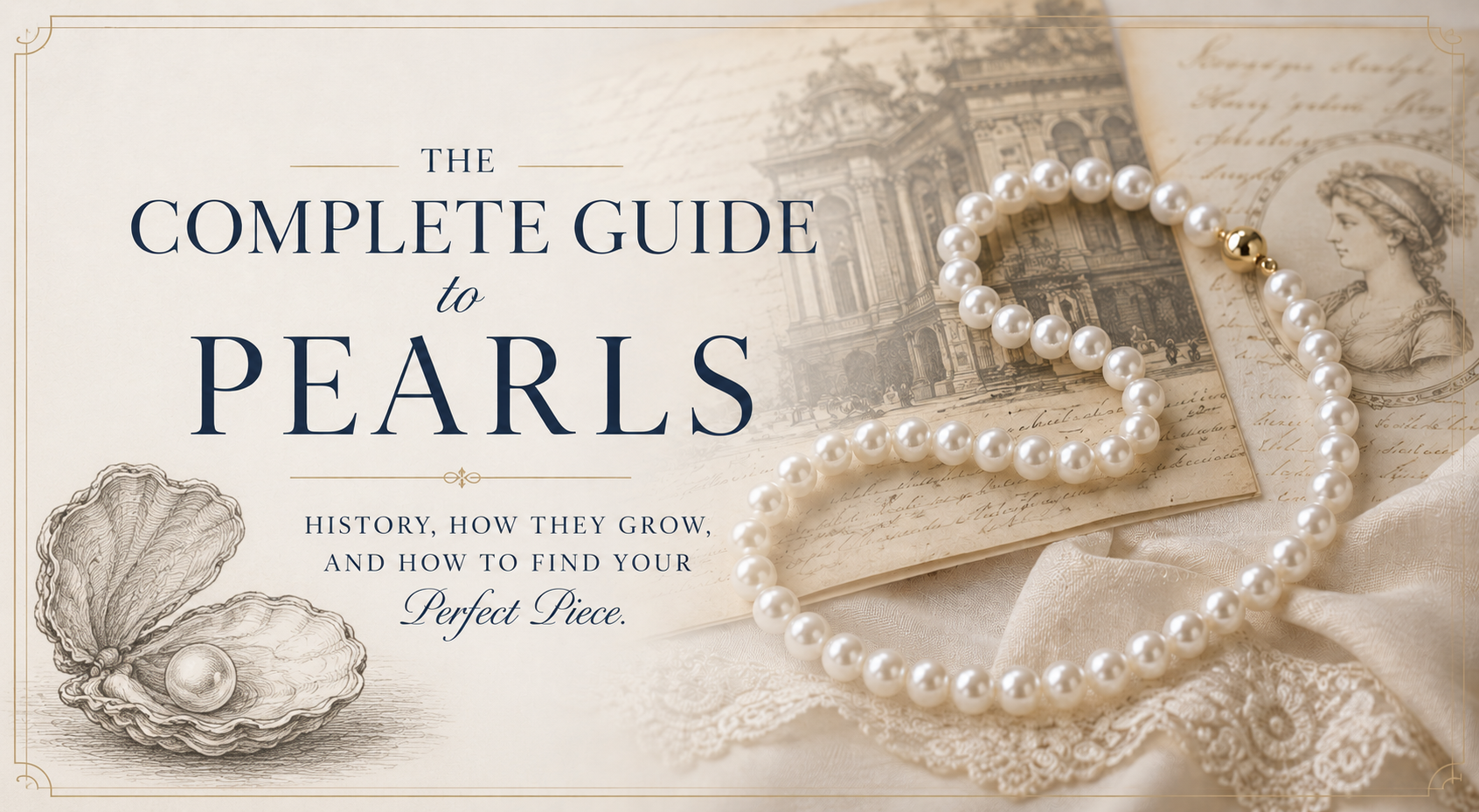
The Complete Guide to Pearls: History, How They Grow, and How to Find Your Perfect Piece
There's something utterly enchanting about a pearl, isn't there?
Unlike every other gem we treasure, it isn't born from rock or fire. It doesn't need to be cut, polished, or treated to reveal its beauty. It comes to us from a living creature, shaped quietly by the sea over months and years; organic and wholly magical. Pearl jewellery has been adorning women for thousands of years, and its allure has never once dimmed.
I've been selling jewellery for a long time, and I can tell you honestly that there is no gem that moves people quite the way a pearl does. Customers pick them up and something shifts. There's a warmth, a softness, a sense of connection to something ancient and beautiful. And right now, I'm thrilled to say we have the most gorgeous new selection of pearl jewellery available both in our Harrogate store and online, so I thought it was the perfect moment to write the pearl guide I've always wanted to write.
Settle in - this is everything you ever wanted to know about pearls.
A Brief History of Pearl Jewellery
Pearls are the oldest gem in human history. And they have never, not once, gone out of fashion.
Long before diamonds were cut and rubies polished, natural pearls were being collected from the sea floors of the Persian Gulf, the Red Sea, and the coastal waters of India. Archaeological evidence suggests that humans have been wearing pearl jewellery for at least 7,500 years, making them quite possibly the very first luxury item we ever coveted.
Ancient Worlds
The Romans were utterly mad for pearls. Julius Caesar is said to have given a pearl worth an extraordinary sum to Servilia, mother of Brutus, and Roman women wore so many pearls that the Senate eventually tried (and failed) to limit them by law. In ancient Persia, pearls were considered the ultimate symbol of wealth and divine favour, worn only by royalty.
The Pearl Age: Renaissance and Elizabethan Britain
The 16th century was pearl jewellery's great moment of excess. Portraits of the era show noblewomen absolutely dripping in them: stitched into gowns, wound through hair, layered at the neck. Elizabeth I of England reportedly owned countless pearl accessories and wore them in almost every official portrait. For her, pearls were power, and unmistakably regal.

Queen Elizabeth I, dripping in pearls. Image courtesy of the National Portrait Gallery
The Victorian Love Affair
Queen Victoria adored pearls, and her influence on jewellery fashion was enormous. Pearl necklaces became beloved wedding gifts during this era, symbolising purity, innocence, and the tears of joy shed on a happy occasion. Mourning jewellery frequently featured pearls, and the romantic symbolism attached to them deepened throughout the 19th century.
Mikimoto Changes Everything
In 1893, Japanese entrepreneur Mikimoto Kōkichi successfully cultured the world's first pearl, and the jewellery world was changed forever. Suddenly, beautiful pearls were no longer the exclusive preserve of royalty and the super-wealthy. Cultured pearls could be worn and enjoyed by all, and the industry that grew from this moment is what gives us the magnificent pearl jewellery we wear today.
Pearls Today
Pearl jewellery is experiencing an extraordinary revival. Designers and fashion icons alike are reimagining pearls in unexpected, contemporary ways, and a whole new generation is falling in love with this ancient gem all over again. It is, without question, one of the most exciting times in pearl jewellery history.
How Pearls Are Made - Nature's Tiny Miracle
Every pearl tells the story of a living creature's extraordinary response to the world. The process of pearl formation is one of nature's most beautiful acts of transformation, and once you understand it, you'll never look at a pearl quite the same way again.
A pearl forms when an irritant - a grain of sand, fragment of shell, or even a tiny parasite - finds its way inside the soft tissue of a mollusc, usually an oyster or a mussel. The mollusc's instinctive response is to protect itself. It begins to secrete a substance called nacre (also known as mother-of-pearl) around the irritant, layer by microscopic layer, in a bid to neutralise the threat.
Over time, thousands of those delicate nacre layers build up. The result? A pearl. Nature at its most poetic.
Cultured Pearls vs Natural Pearls
You may have seen the term cultured pearls and wondered whether they are somehow inferior to natural pearls. They absolutely aren't. A cultured pearl is formed by exactly the same biological process as a natural pearl. The only difference is that the initial irritant is introduced by a human hand rather than by chance. The nacre, the lustre, the beauty, all of it is entirely the oyster's own work.
In a cultured pearl, farmers carefully insert a small bead nucleus (usually made from mussel shell) along with a piece of mantle tissue into the host mollusc. The oyster then does what oysters do; it starts building nacre around the nucleus, layer by microscopic layer.
The mollusc adds each nacre layer at only 0.5 microns thick. A freshwater pearl might have hundreds of nacre layers; a high-quality saltwater pearl can have over a thousand. This is what gives a fine pearl its deep, luminous glow, and why nacre thickness matters so much when it comes to quality.
Today, almost all pearl jewellery features cultured pearls. Genuinely natural, uncultured pearls are extraordinarily rare and command extraordinary prices at auction. When you see pearl jewellery in a reputable jeweller's, including ours, you can be confident you are looking at a beautifully cultured pearl.
Types of Pearls: A Guide
Not all pearls are alike, far from it. The world of pearl jewellery is wonderfully varied, with different types each offering their own distinct character, colour palette, and price point.
Freshwater Pearls
The most widely available pearl, and wonderfully versatile. Freshwater pearls are grown primarily in China's rivers and lakes. They come in an extraordinary range of shapes, sizes, and natural colours, and they typically have very thick nacre, making them beautifully durable. An excellent choice for everyday pearl jewellery and a brilliant starting point if you're new to pearls.
Akoya Pearls
The classic pearl. Round, bright, and mirror-like in lustre, Akoya pearls are what most people picture when they think of a traditional pearl necklace. They range from creamy white to pale pink and are typically smaller (5–11mm). The go-to for timeless, polished elegance.
South Sea Pearls
The queen of pearls. South Sea pearls are the largest of all cultured pearls - often reaching 10–20mm - and grow thick, luxurious nacre coats over many years in the warm waters of Australia, the Philippines, and Indonesia. Their colour ranges from brilliant white and silver to deep, rich golden yellow. They have a soft, satiny lustre that is uniquely and unmistakably their own.
Tahitian Pearls
Often called "black pearls", Tahitian pearls are in fact a spectacular range of dark colours: deep greens, peacock blues, midnight grey, aubergine, and everything in between. They are bold, dramatic, and utterly unique. Grown in French Polynesia, no two are quite alike, and they suit women who want something genuinely individual.
Baroque Pearls
Baroque pearls are irregular, asymmetric, and wonderfully characterful. No two are the same shape. Once overlooked in favour of perfect rounds, baroque pearls have had a spectacular fashion renaissance and are beloved by contemporary jewellery designers for their organic, sculptural beauty. If you love jewellery with personality, baroque pearls are for you.
Keshi Pearls
Keshi pearls are tiny, all-nacre pearls that form as a byproduct of the culturing process. Because they contain no nucleus, they are entirely nacre, meaning they can have truly exceptional lustre. Their organic, freeform shapes make them a favourite for contemporary fine jewellery.

A classic strand of Akoya pearls
What Makes a Quality Pearl? The Six Factors
Unlike diamonds, pearls don't have a single universally standardised grading system, but the jewellery industry evaluates them across six key factors. Understanding these will help you choose your pearl jewellery with real confidence.
1. Lustre - The Most Important Factor of All
Lustre is the depth, brilliance, and reflective quality of a pearl's surface; that extraordinary lit-from-within glow that makes a fine pearl so mesmerising. High-lustre pearls are mirror-bright; you should almost be able to see your own reflection in them. Lustre is created by the interaction of light with the microscopic layers of nacre, and thicker nacre generally means finer lustre. When you're choosing pearls, start here.
2. Nacre Quality and Thickness
Nacre is the substance that makes a pearl a pearl. Nacre thickness is critical; thicker nacre means greater durability, deeper lustre, and richer colour. The very best pearls have nacre that has been building for years. Thin-nacre pearls (sometimes seen in very inexpensive pieces) can look chalky, and over time they may wear through to the bead nucleus.
3. Shape
Perfectly round pearls are the rarest and most traditionally prized, forming a perfect sphere is genuinely difficult for an oyster to achieve. But shape is very much a matter of personal taste. Baroque, drop, oval, button, and circle pearls are all beautiful and desirable in their own right. Many of the most exciting contemporary pearl jewellery designs specifically celebrate irregular, organic shapes.
4. Surface Quality
Few pearls are entirely free of surface characteristics: tiny ridges, bumps, or spots are a perfectly natural part of an organic gem's formation. The finest pearls have the cleanest, smoothest surfaces. Small, faint imperfections on the back of a pearl are largely inconsequential. Blemishes that are very noticeable or affect the pearl's durability reduce quality and, consequently, value.
5. Colour
Pearl colour has two components: the body colour (the pearl's primary hue — white, cream, pink, gold, black, grey) and the overtone (a secondary, translucent colour that floats across the surface — rose, silver, green, or peacock). The most desirable colour combination varies by pearl type: rose overtones are prized in Akoya pearls; green overtones are coveted in Tahitian pearls; golden body colour is the hallmark of the finest South Sea pearls. Choose the colour that speaks to you.
6. Size
Larger pearls are rarer and therefore more valuable; a larger oyster is needed, and more time is required for the nacre to form. Pearl size is measured in millimetres. Freshwater pearls typically range from 5-12mm; South Sea pearls can reach 20mm or more. For pearl necklaces, the size of each pearl and the consistency of matching across the strand both affect quality and value.
Pearls Are Timeless, and Here's Why
What other gem can claim to have been fashionable for 7,000 years and shows absolutely no sign of stopping?
Pearl jewellery occupies a unique position in the world of fine gems: it is simultaneously the oldest jewellery we wear and one of the most contemporary. No other stone has managed to remain desirable across every culture, every century, every fashion revolution. That is no accident. Pearls are chameleons of elegance: they adapt, they transform, they remain utterly, enduringly relevant.
In the Elizabethan era, pearls were symbols of power and royal magnificence. In the Victorian period they became tokens of sentiment and romance. The Edwardians wore multi-strand pearl necklaces to signal refinement. In the roaring twenties, long ropes of pearls became icons of modern femininity. The mid-century saw the single strand become the essential accessory of every well-dressed woman. And today? Pearls are everywhere: worn with trainers and denim just as readily as with evening gowns, stacked, layered, mismatched, and reimagined by the most exciting designers working today.
Famous Women Who Made Pearls Iconic
Some of the most captivating women in history have shared one thing in common: a deep, abiding love of pearls.
Elizabeth I of England made pearls her signature and her symbol. Her portraits are extraordinary: gowns stitched with thousands of pearls, ropes wound into elaborately dressed hair, lustrous strands layered at the neck. For Elizabeth, pearls weren't simply beautiful; they were political. They spoke of purity, of power, of a queen who answered to no one. No other monarch has so completely made a gem her own.
Marie Antoinette was one of the greatest jewellery collectors in history, and pearls held a special place in her legendary collection. She owned some of the most important natural pearls ever recorded, including a magnificent pearl pendant that sold at auction in 2018 for a breathtaking $36 million; the most valuable pearl jewel ever sold. That a pearl worn by the last Queen of France still commands such reverence three centuries later tells you everything about the enduring power of this gem.
Queen Elizabeth II wore her triple-strand pearl necklace - a gift from her father, King George VI - for much of her reign, appearing in many of her most iconic official portraits wearing it. It became as synonymous with her image as the Crown itself. Her sister, Princess Margaret, brought a more glamorous, fashion-forward energy to pearls, wearing them with the confidence and flair of a true mid-century style icon, pairing them with bold colours and statement looks that felt entirely, unapologetically her own.

Princess Margaret at 19: timeless elegance. Image courtesy of British Vogue
Jackie Kennedy, arguably the most stylish woman of the 20th century, elevated the simple pearl necklace to an art form. Her triple-strand pearls, worn throughout her time in the White House and beyond, became one of the most copied jewellery looks in history. She understood instinctively what so many women have since discovered: that pearls have a softness and a luminosity that flatters every skin tone and works with absolutely everything.
Princess Diana had a relationship with pearls that evolved beautifully throughout her life. In her early royal years she wore classic single strands with quiet elegance; later, she layered them, mixed them, and wore them in ways that felt warm, personal, and entirely her own. The pearl choker she wore on numerous occasions, often stacked with other necklaces, became one of her most beloved signatures. Diana had a gift for making jewellery feel like an extension of herself rather than a statement of status, and her pearls were no exception.

The epitome of modern elegance: Jackie Kennedy. Image courtesy of the National Portrait Gallery
How to Care for Your Pearl Jewellery
Pearls are organic gems, and they deserve a little extra love to keep them looking their very best.
Put them on last, take them off first. Always put your pearl jewellery on after perfume, hairspray, and cosmetics, and remove it before you undress. Pearls are vulnerable to chemicals, including those found in everyday beauty products, which can erode the nacre over time and dull that gorgeous lustre.
Clean gently. Wipe your pearls with a soft, damp cloth after wearing to remove body oils and perspiration. Never use ultrasonic cleaners, steam cleaners, or harsh chemical jewellery solutions on pearls - a gentle wipe is truly all they need.
Store separately. Pearls are softer than most gemstones and can be scratched by harder stones and metals. Store them in a soft pouch or lined jewellery box away from other pieces. Pearl necklaces are best laid flat rather than hung, to prevent the silk thread from stretching.
Wear them often. Here's a pearl care secret: pearls actually benefit from being worn. The natural oils in your skin help maintain their lustre. Pearls kept locked away for years can dry out and dull. So wear them, enjoy them, love them and they'll thank you for it.
Re-string regularly. If you wear your pearl necklace often, it's worth having it re-strung by a professional jeweller every few years. The silk thread weakens over time, and re-stringing ensures your pearls are knotted between each stone, so if the thread does break, you won't lose your precious collection.
Come and See Our Beautiful New Pearl Collection
We are so excited to share that we have a stunning new selection of pearl jewellery available right now, both in our Harrogate store and online.

Pearls and diamonds, what more could a girl want?
Whether you're looking for a classic pearl necklace, a pair of delicate pearl stud earrings, a contemporary baroque pearl pendant, or something truly special to mark a milestone occasion, we have something beautiful waiting for you. Our collection spans freshwater and cultured pearls across a wonderful range of styles and price points, every single piece chosen for the quality of its lustre, the beauty of its nacre, and its lasting, wearable elegance.
Come in and see us. There is genuinely nothing quite like holding a beautiful pearl in your hands, and I would love to help you find yours.
With love, Mona & the team at Fogal & Barnes Fine Jewellers
14 Cambridge Street, Harrogate, North Yorkshire