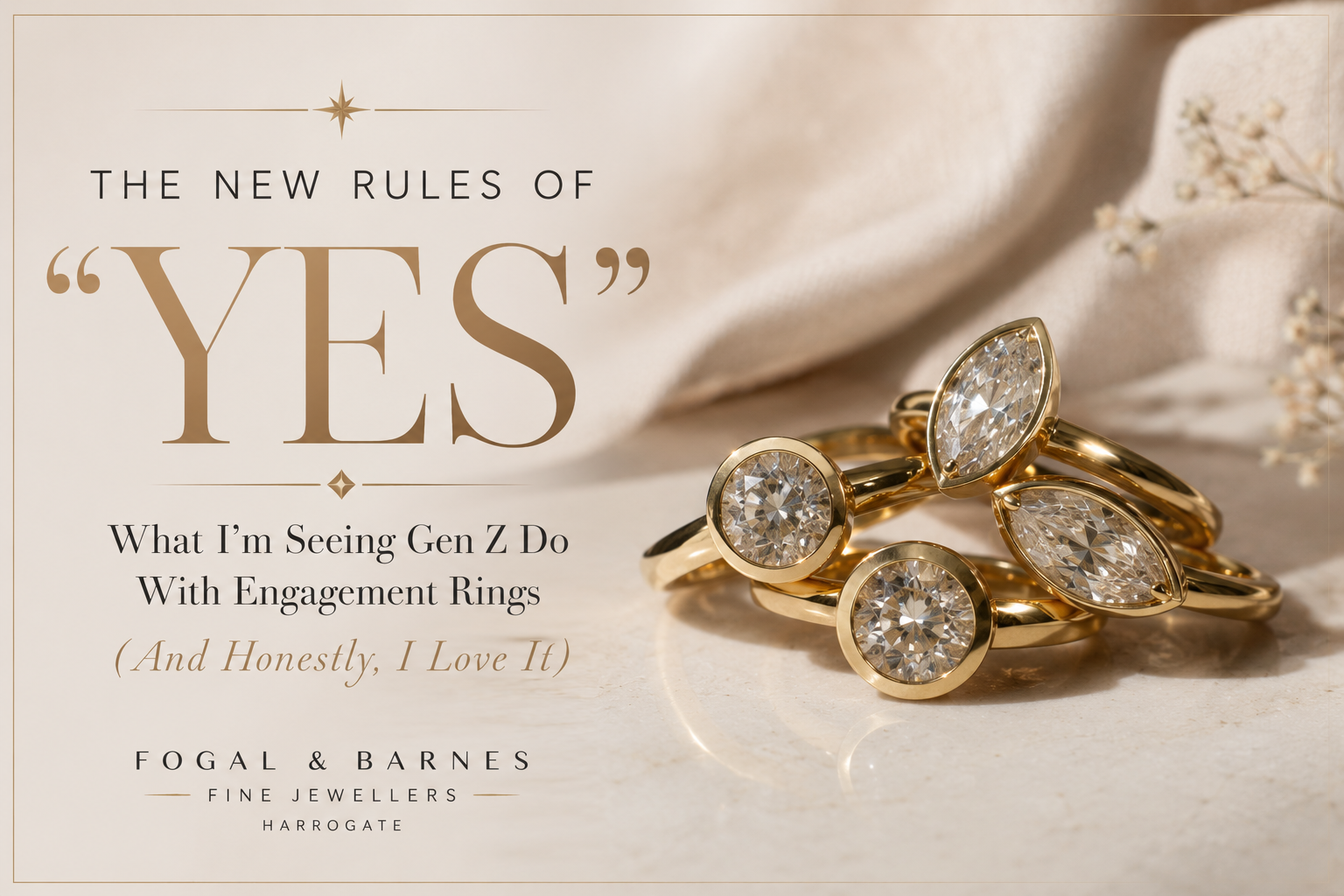


Shape Wars & Setting Showdowns: The Lab-Grown Diamond Decisions Dividing Brides Right Now
There is a conversation happening right now in jewellery studios across Yorkshire, and we hear it every single week at Fogal & Barnes. A couple comes in, often having spent an evening down a Pinterest rabbit hole or spent their lunch break Googling "best lab-grown diamond engagement ring", and they arrive with one very specific question: oval or elongated cushion? And a close second: claw or bezel?
These aren't just idle style musings. They are the defining engagement ring decisions of the moment, and for good reason. As lab-grown diamonds have made genuinely beautiful, larger stones accessible to far more couples - whether you're dreaming of a1ct, a 2ct, or a show-stopping 3.5ct, or even 5ct centre stone - the question of which shape and how it's set has never felt more exciting, or more fiercely debated.
So, let's settle in, shall we? Here is your definitive guide to the great shape-and-setting debate; what each choice offers, who it's for, and how to know which side you're on.
Round One: The Oval Cut - Timeless, Brilliant, and Endlessly Flattering
A Brief History
The oval brilliant cut as we know it today was developed in the early 1960s by Lazare Kaplan, a Russian-born diamond cutter working in the United States. His innovation was to take the brilliant-cut facet pattern (that arrangement of triangular and kite-shaped facets that gives round diamonds their extraordinary fire) and apply it to an elongated, curved shape. The result was a stone that combined classic diamond brilliance with a silhouette that felt fresh, romantic, and undeniably feminine.
It gained traction through the latter half of the twentieth century, appeared on the hands of some very famous women, and then - around 2015 - it absolutely exploded. For the better part of the last decade, the oval cut has been the it shape. The finger-elongating, light-catching, modern-yet-timeless choice.
What Makes the Oval Special
The oval diamond's secret weapon is its face-up size. Because of its elongated shape and relatively shallow depth, an oval diamond of the same carat weight as a round will almost always look larger on the hand. For anyone considering a lab-grown oval engagement ring and weighing up a 1.5ct versus a 2ct, or a 2.5ct versus a 3ct, this is a meaningful advantage. You get more visual stone for your investment.
Then there is the finger effect. The oval's elongated form genuinely does create a lengthening, slimming illusion on the hand — a quality that many wearers find flattering regardless of finger shape or size. Paired with a slim platinum or yellow gold band, a well-cut oval can look extraordinary.
Technically, the oval belongs to the brilliant-cut family, which means it produces that classic diamond sparkle: a dynamic, scintillating play of white and coloured light. This is the sparkle people typically picture when they think "diamond engagement ring." It catches light from every angle, in every kind of light — candlelight, natural light, the fluorescent glow of an office. An oval never looks dead.
One note worth understanding: oval diamonds can exhibit what is known as a "bow-tie effect" — a dark, shadow-like area across the width of the stone. This is not a flaw, exactly, but a matter of degree. A slight bow-tie is normal and often imperceptible; a pronounced one can detract from the stone's beauty. This is one reason we always encourage clients to view their oval diamond in person before purchasing, which is something we're very well set up for here at our Harrogate studio.
Who Chooses the Oval?
In our experience, the oval tends to appeal to women who describe themselves as "classic but not boring." They love diamonds, want undeniable sparkle, but don't necessarily want to wear the same round solitaire as everyone else. They are often drawn to clean, elegant lines. They appreciate that the oval has a history — it isn't a passing trend — while still feeling very much of the moment.
Celebrities who have worn oval engagement rings include Hailey Bieber, whose ring (and the broader "Bieber effect" it sparked) is credited with influencing engagement ring aesthetics for half a decade. Georgina Rodríguez, partner of Cristiano Ronaldo, also wears an oval, as does Winnie Harlow. The oval has earned its place as the choice of women who know exactly what they want and want it to be impeccable.
Round Two: The Elongated Cushion Cut — Romantic, Vintage-Inspired, and Unmistakably Now
A Brief History
The cushion cut's roots reach back to the eighteenth century, when the Old Mine cut (a precursor with a high crown, large facets, and a small table) was the dominant diamond shape. Stones like the Hope Diamond and the Regent Diamond are famous examples. Through the nineteenth century and into the Edwardian era, this pillow-shaped cut was the standard; you'll find it in antique rings everywhere from Harrogate antique fairs to the cases at Leeds jewellers. It was the diamond of the romantic age.
The modern cushion cut retains that vintage soul but has been refined considerably — today's stones typically have between 64 and 77 facets, far more than their historic predecessors, giving them superior brilliance while preserving that characteristic warmth and glow. The elongated variation stretches the traditionally squarish cushion into a soft rectangular shape, with a length-to-width ratio typically between 1.15 and 1.30 for the classic "sweet spot."
What Makes the Elongated Cushion Special
If the oval is crisp, bright brilliance, the elongated cushion is something richer and more atmospheric. Its larger facets produce what enthusiasts often describe as broad, romantic flashes of light — a warm, glowing sparkle that feels different from the pinpoint scintillation of a brilliant cut. In candlelight, in the golden hour, at a wedding reception — the elongated cushion absolutely sings.
The shape also offers something unique in terms of finger coverage. Its wider top surface means it sits with more presence on the hand, making it a statement without needing an enormous carat weight. A beautifully cut 1.5ct elongated cushion can have the visual impact of something considerably larger.
There is also the matter of versatility in settings. The elongated cushion has a more symmetrical appearance than the oval; it reads as intentional and architectural in a way that suits both traditional solitaires and contemporary east-west settings beautifully. Three-stone rings with elongated cushion centres are particularly stunning, with the side stones echoing the romantic curves of the centre.
One technical consideration: elongated cushion cuts can come in two distinct styles — a standard brilliant-facet pattern, and what is called a "modified" or "crushed ice" pattern. The crushed ice effect produces smaller, scattered sparks of light, like its namesake. It is a genuinely acquired taste; some people find it mesmerising, others prefer the cleaner flashes of a standard cushion. Both are beautiful; it simply comes down to which kind of sparkle speaks to you.
A Story From Our Studio: When Exact Becomes Possible
This is perhaps the moment to share a story that illustrates beautifully what lab-grown diamonds make possible and why, increasingly, clients are willing to travel a very long way to find exactly the right ring.
Not long ago, a lovely couple came into our Harrogate studio with a very specific brief. She knew precisely what she wanted: an elongated cushion cut diamond with a length-to-width ratio of 1.5. For anyone new to diamond proportions, the length-to-width ratio is simply how you measure how elongated a stone is. You take the length of the diamond — its longer dimension, measured in millimetres — and divide it by the width, the shorter dimension. A perfectly square cushion has a ratio of 1.0. A gently elongated cushion might be 1.15 or 1.20. At 1.30 you have something noticeably rectangular. At 1.5, you have a dramatically elongated stone - long, sleek, and genuinely arresting on the finger. It is a bold, specific, and beautiful choice.
The trouble was, we couldn't source one. A 1.5 ratio elongated cushion in the carat weight she had in mind simply wasn't available from existing stock, and this is not unusual. Naturally mined elongated cushion cuts at more extreme ratios are rare, because cutting to such proportions wastes a significant amount of expensive rough stone. Historically, cutters preferred to retain as much carat weight as possible, which nudged shapes towards squarer proportions.
But here is where lab-grown diamonds change everything. Because we are able to have lab-grown diamonds cut entirely to specification, we did exactly that. We had her diamond made, her elongated cushion, at precisely a 1.5 length-to-width ratio, in the carat weight she wanted. She left with a ring that could not have existed any other way.
This story matters beyond its happy ending. It speaks to something fundamental about what lab-grown diamonds have unlocked for the modern engagement ring buyer. With mined stones, you work within the constraints of what the earth has produced and what a cutter has chosen to do with it. With lab-grown diamonds, the stone itself can be grown and cut to your vision. Want a specific length-to-width ratio? We can work to that. Want a particular depth percentage to maximise brilliance in a bezel setting? Done. Want something that sits stylistically between an elongated cushion and an oval? There is far more scope to explore it. For clients with a clear picture in their minds - and in our experience, the most passionate and engaged clients almost always do have that clear picture - lab-grown diamonds mean that "we can't find that" need never be the answer.
Who Chooses the Elongated Cushion?
The elongated cushion tends to attract women who have a strong sense of aesthetic individuality. They love the feeling of wearing something with history; something that looks as though it could have come from a grandmother's jewellery box, or been pulled from the pages of a period drama, but reinterpreted for modern life. They are often drawn to yellow gold settings, to vintage-inspired details, to the idea of a ring that tells a story.
Celebrities have been enormously influential here. Taylor Swift's engagement ring from Travis Kelce, an antique elongated cushion cut diamond on a hand-engraved yellow gold band, became one of the most discussed jewellery moments of 2025. Zendaya's engagement ring from Tom Holland, a reported five-carat elongated cushion set east-west in a bezel mounting, added another dimension of influence. Miley Cyrus chose an elongated cushion too, set in a bold yellow gold band. Sofia Vergara, Chrissy Teigen, Kim Kardashian, and Gabrielle Union have all worn this shape. It is, without question, having its greatest cultural moment ever, and lab-grown diamonds have made it accessible at every carat weight, from 1ct right up to 4ct and beyond.
Setting One: The Claw Setting — The Classic That Never Loses
Now we turn to settings, and here the conversation gets equally passionate.
The claw setting (known as a prong setting in the United States) is what most people picture when they close their eyes and think "engagement ring." A centre stone held aloft by slender fingers of metal, typically four or six, allowing maximum light to flood in from every direction. It is the setting of the classic solitaire engagement ring, the one that has defined proposals for over a century.
Why the Claw Endures
Its longevity is entirely deserved. The claw setting does one thing exceptionally well: it shows off the diamond. With minimal metal obscuring the stone's girdle, a well-set oval or elongated cushion in a claw setting catches light from virtually every angle. The diamond floats, rather than sits; it is airy, brilliant, and, depending on your band choice, can look as delicate or as substantial as you like.
For lab-grown diamond buyers specifically, the claw setting is a natural choice if you have invested in a high-quality stone with excellent cut, colour, and clarity. You want to see it. A slim platinum four-claw or six-claw solitaire on an oval lab diamond is clean, timeless, and frankly beautiful on practically everyone.
Claw settings can be personalised endlessly: the number of claws (four creates a more elongated look; six provides more security and a more traditional feel), the shape of the claw tips (pointed for vintage drama, rounded for everyday wearability, flat for a modern finish), and the band style from knife-edge to pavé all add layers of individuality.
The practical consideration: claws do require occasional maintenance. They can snag on fabrics, and over years of daily wear, claw tips may need re-tipping by a jeweller. For an active lifestyle, this is worth considering - though regular checks (something we offer here at Fogal & Barnes) make it very manageable.
Setting Two: The Bezel Setting — The Modern Minimalist's Dream
The bezel setting, in which a thin rim of metal encircles the girdle of the diamond, has been around for centuries. It is, in fact, one of the oldest setting styles in jewellery history. And yet it feels absolutely of the moment right now — appearing on some of the most talked-about engagement rings of the last two years.
Why the Bezel Is Having Its Moment
Bezel settings are trending for several converging reasons, and celebrity influence is chief among them. Zendaya's east-west cushion in a button-back bezel mounting attracted enormous attention. Taylor Swift's ring incorporates bezel elements. Dua Lipa's much-admired round diamond on a chunky yellow gold band uses what appears to be a semi-bezel. Selena Gomez's ring also features bezel detailing. The bezel holds the stone snugly in place, making it a practical and stylish choice for everyday wear.
The bezel's aesthetic appeal lies in its clean, sculptural quality. The metal rim frames the diamond like a portrait in a gallery — it gives the stone definition and presence without the fussiness of multiple prongs. For elongated shapes in particular, a bezel can create a beautiful, fluid line along the finger.
Practically speaking, the bezel setting offers unrivalled security. Because the metal surrounds the diamond's edge, dirt doesn't build up underneath as easily as in claw settings, and there are no prongs to snag or bend. For wearers with active jobs or those who work with their hands, a bezel setting on a lab-grown diamond engagement ring can mean years of worry-free daily wear.
The trade-off is a small reduction in light entry at the diamond's sides, which can slightly reduce sparkle compared to a claw setting. For this reason, if sparkle is your absolute priority, we always recommend prioritising an excellent cut grade when choosing a bezel-set stone. A superbly cut oval or cushion in a bezel will still be breathtakingly beautiful — the light simply comes from a slightly different angle.
The Metal Question: Yellow Gold Is Glorious, Platinum Has Come Into Its Own
No engagement ring conversation is complete without the metal discussion, and the landscape has shifted considerably in recent years.
Yellow Gold: Not a Trend, a Return
For the first time, yellow gold has overtaken platinum as the top choice for engagement rings, representing 57% of engagement ring sales, up from 45% the previous year. This is a cultural shift that has been building for years, driven by a broader embrace of warm, vintage-inspired aesthetics, what fashion commentators have called "old money" and "heirloom" sensibilities.
Yellow gold and the elongated cushion cut are, it must be said, a particularly perfect match. Taylor Swift's antique cushion on a hand-engraved yellow gold band is the most obvious example, but the combination has a deeper logic: the warm glow of yellow gold complements the romantic, broad-flash sparkle of the cushion cut in a way that feels both historically resonant and utterly contemporary. Many of our clients from York and the wider Yorkshire region who are drawn to vintage aesthetics end up in yellow gold almost instinctively.
Yellow gold also pairs beautifully with oval diamonds, particularly in bezel settings, where the continuous metal line creates a fluid, jewellery-forward look. It flatters every skin tone, stacks naturally with plain wedding bands, and carries an inherent warmth that white metals simply cannot replicate.
At Fogal & Barnes, we stock 18ct yellow gold settings and can advise on the specific alloy grades best suited to different setting styles.
Platinum: The Quietly Confident Choice
Platinum follows yellow gold at 42% of sales, while white gold and rose gold have each dropped to under 1%, a remarkable shift. White gold, which dominated bridal jewellery for years, has essentially been replaced by its two more premium alternatives.
The reason platinum has surpassed white gold is partly a matter of practical value and partly one of aesthetics. Platinum is denser, more durable, and naturally white, it requires no rhodium plating and will not develop a yellowish tint over time. As the relative cost of platinum has moderated compared to previous decades, it has become a genuinely accessible upgrade over white gold rather than an aspirational luxury. For buyers of lab-grown diamonds at 1ct, 2ct, 2.5ct and above, choosing platinum rather than white gold is a meaningful quality decision that will serve the ring well for decades.
Platinum's cool, almost silvery-white tone is the ideal showcase for a colourless or near-colourless diamond. A 2ct lab-grown oval in a slim platinum four-claw solitaire is (and we say this with considerable professional confidence) one of the most beautiful engagement ring choices available. It is timelessly elegant, supremely wearable, and will look just as relevant in forty years as it does today.
Making Your Decision: A Few Honest Questions
After years of helping couples in Harrogate, Leeds, York, and beyond find their perfect ring, we've noticed that the choice between these shapes and settings often becomes clear quite quickly once you ask the right questions.
Do you love diamond sparkle in the most classic, brilliant sense — crisp, scintillating, dynamic? Then you want an oval. Do you want warmth, romance, a glow that feels old-world and personal? Then you want an elongated cushion.
Do you love the feeling of a diamond that looks like it's floating, held up to the light by elegant metal fingers? Then you want a claw setting. Do you want clean architecture, security, and a ring that feels like a piece of sculpture? Then you want a bezel.
And on metal: do you want warmth, vintage character, and a ring that feels found rather than bought? Yellow gold. Do you want clean, cool, contemporary, and heirloom-quality durability? Platinum.
Of course, and this is the genuinely wonderful thing about visiting an independent jeweller rather than clicking through a website — these choices are rarely either/or. A yellow gold bezel-set oval lab diamond is an extraordinary thing. An elongated cushion in a platinum claw solitaire with a pavé band is breathtakingly beautiful. The combinations are many, and part of our pleasure at Fogal & Barnes is working through them with you in person, with stones in hand.
Come and See Us in Harrogate
We are proud to be an independent, family-run jewellery destination in the heart of Harrogate, and the truth is that our clients come from a great deal further than you might expect. Yes, we see wonderful couples from across Yorkshire — from Leeds, York, Skipton, Knaresborough, and the surrounding dales — but we also regularly welcome clients from Manchester, Birmingham, and London, and occasionally from further afield still. People travel for the right ring. They travel for expertise, for personal service, and, particularly when it comes to lab-grown diamonds and bespoke requirements, for a jeweller who will say "yes, let's make that happen" rather than "I'm afraid we don't have that in stock."
The story of our 1.5 ratio elongated cushion client is one example of many. The engagement ring market has changed dramatically, and so have the expectations and knowledge of the people buying rings. Today's customers arrive having done their research - they know their length-to-width ratios, their preferred carat weights, their metal choices. They deserve a jeweller who can match that knowledge and go further. That is what we offer.
Whether you are beginning your search for a lab-grown diamond engagement ring and wondering whether a 1ct oval or a 1.5ct elongated cushion suits your hand better, or you are further along and deciding between platinum and yellow gold, between claw and bezel, we are here for every stage of that conversation.
Our lab-grown diamond collection includes stones from 1ct through to 4ct and beyond, across all the shapes and settings we've discussed here. We can show you the difference between a 2ct and a 2.5ct in your chosen shape, side by side. We can point out a bow-tie on an oval and help you decide whether it matters to you. We can show you the difference between a brilliant cushion and a crushed-ice cushion in the same afternoon light. And if what you want doesn't exist yet, we can make it.
Because a decision this significant — one you'll make once and wear every day — deserves to be made with your own eyes and your own hands. Wherever you're travelling from, we'd love to see you.